The Engineering Legacy of Trollstigen
Opened by King Haakon VII in 1936 after eight arduous years of construction, the Trollstigen mountain pass links Åndalsnes on the Romsdalsfjord with Valldal on the Storfjord. The engineering marvel negotiates an 850-metre elevation change across eleven severe switchbacks with a sustained gradient of approximately 10 percent.
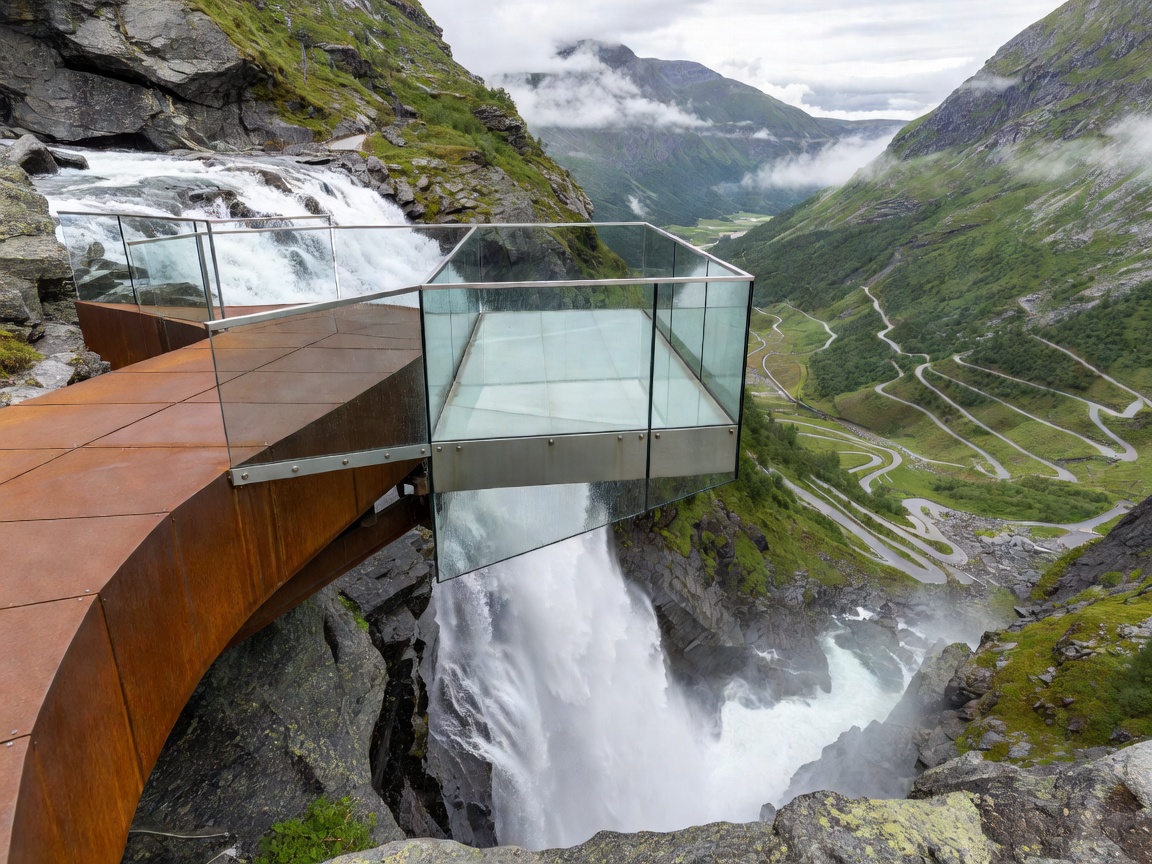
Halfway up the mountain flank, the road crosses the deafening torrent of Stigfossen across a stone-arch bridge built by manual stonemasons. The waterfall plunges 320 metres down the valley walls. However, the most complete side-perspective of this interplay between civil infrastructure and wild hydrologic force is attained from the crest at the Trollstigplatået visitor centre.
The Architectural Walkway System
Designed by Reiulf Ramstad Arkitekter, the Trollstigen Plateau development consists of a low-profile visitor center housing service areas and an exhibition space, flanked by a network of cast-concrete ramps and corten steel bridges. The pathway meanders along rushing snowmelt channels, stepping down to two primary lookout pavilions:
| Vantage Point | Elevation & Structure | Photographic Perspective |
|---|---|---|
| Lower Cantilever Platform | Suspended 200m above valley floor; steel girder base | Direct lateral view of Stigfossen falls; full switchback stack |
| Upper Crest Terrace | Flush concrete deck adjoining visitor centre | Panoramic sweep toward the peaks of Bispen, Kongen, and Dronningen |
| Stigfossen Bridge (Road level) | Ashlar stone masonry arched bridge | Ground-level immersion directly within the spray zone |
The lower cantilever platform is a singular architectural achievement: it terminates in a high-tensile glass balustrade that hovers directly over the tumbling water of Stigfossen. Looking down from this platform gives travellers a cross-sectional side view of vehicles navigating the hairpins like miniatures against the dark, lichen-stained stone.
Roadway Characteristics & Safety Mandates
Because of rockfall hazards along the sheer cliffs and the narrow turning radius of hairpin curves, vehicles longer than 13.1 metres are legally prohibited from driving Trollstigen. Furthermore, drivers must anticipate rapid thermal changes; descending vehicles generate extreme heat in braking systems, making the use of low engine gears essential.
Route Evaluation: Advantages & Restraints
- Architectural Integration: The oxidized corten steel integrates naturally into the alpine landscape, providing high-friction footing even during rain and early morning frost.
- Unrivalled Engineering Vista: It offers one of the few vantage points in the world where both an entire mountain road network and a major waterfall can be observed simultaneously from above.
- Strict Seasonal Window: Due to snowpack and rockfall remediation, the pass typically opens in late May or early June and closes between mid-October and November.
- Frequent Rockfall Closures: Geotechnical monitoring can result in temporary route suspensions if stone displacement occurs on the upper rock walls.
Best Practices for Visiting Trollstigen
To witness Trollstigen in optimal conditions, plan an arrival either before 09:00 or after 17:30 during the summer solstice period. During these hours, the low northern sun cuts laterally through the Isterdalen valley, illuminating the airborne mist of Stigfossen without producing harsh overhead glare on the wet asphalt.